
Terminator 2 Judgment Day story
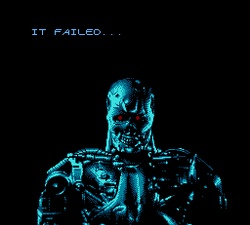
It didn’t kick off with a menu or a “Press Start.” It started with that metal riff stuck in your head, VHS cover art on the wall, and stairwell chatter. When Terminator 2: Judgment Day hit our living rooms, everyone quickly settled on a warm shorthand: “Terminator 2 on Dendy.” Some called it “T2,” others “T2: Judgment Day,” and the local expert always added, “the game based on the movie — don’t mix it up with the arcade shooter.” Cartridge labels were a wild mix: from the tidy “Terminator 2: Judgment Day” to proud Cyrillic “ТЕРМИНАТОР 2.” But the message was clear: you were about to get chases, rescues, and an endless hunt for the T‑1000 — the liquid-metal Terminator we saw on the big screen and couldn’t wait to beat in pixels.
How the 8‑bit version came to life
The film’s success was thunderous, and license holders weren’t sleeping. The rainbow LJN logo flashed everywhere, and UK studio Software Creations got the sweetest impossible brief: squeeze a blockbuster — the bike chases, Pescadero hospital, Cyberdyne Systems, and that steel-mill finale — into a neat 8‑bit frame. They went with a “greatest hits” approach: pick iconic beats and capture the vibe — not a scene-for-scene edit, but a game you could finish, replay, and, of course, dissect at school the next day.
By the standards of the time it mixed just right: episodic missions, snappy cutscenes with character portraits, music that grabbed Brad Fiedel’s icy pulse and poured it into an 8‑bit sound chip. Above all — recognizability. John’s dirt bike, the whistling flood channel, the factory heat — one screenshot told you where you were and who you were up against. It was exactly what you wanted from Terminator 2: Judgment Day on a home console.
The road to us: carts, stickers, and neighborhood legends
Where we lived, the Dendy was your passport to the 8‑bit world, and “Terminator 2 on Dendy” sounded like a password. Cartridges changed hands nonstop: one block had a yellow shell with loud artwork, another a plain gray rectangle with a worn-off label. On multicarts like “9999 in 1,” the title might hide around menu number forty‑something — cue the ritual: scroll, boot, check, “not it? next.” Sometimes you got the classic bait-and-switch: you’re waiting for Judgment Day and launch the “arcade one” — that other T2, the light-gun shooter. Hence the playground taxonomy: “shooter — arcade” vs “the real one — with levels.” We liked both, but we spoke warmer about “the real one” — “it’s like the movie.”
Bootleg stickers followed no rules and lived their own life. One showed Schwarzenegger with a shotgun and an English tagline, another had Cyrillic and promised “new stages,” even though the stages were the same — canal, hospital, Cyberdyne, foundry. Still, every new cart felt like a chance: maybe this one makes the T‑1000 finale easier, maybe this one has “codes and secrets.” Rumors spread faster than actual tips. Someone swore there was “a password to the last level,” someone else claimed “if you don’t shoot the guards in Cyberdyne’s offices you get a different ending” — sweet playground mythology that only fanned the hype.
Why we loved it
Our love for T2 on Dendy wasn’t about shot-for-shot accuracy — it was about feeling the movie at your fingertips. It’s a straight-up side-scroller with a nerve: you know the scene you need to reach and watch the 8‑bit machine sell it in its own language. The canal and freeway chases — simple lines, perfect pace. The Cyberdyne break‑in — that same urgency that tells you to move now. The steel mill — hot, red, burned into memory, because that’s where each of us tried to finish off the boss and silence the T‑1000’s last twitch.
The soundtrack deserves its own shout‑out. Not every NES trick can bottle the Terminator’s steel timbre, but this one got close: heavy basslines, tight loops that kept you wired, and on pause you could almost hear a cold bolt click. For many, it was the first “movie game” where the music wasn’t just wallpaper — it set the mood: first you hide, then you push, then you grit your teeth at the boss.
And then there was the magic of block talk. We didn’t argue about “game design,” we argued about “how to beat it.” “Walkthrough” wasn’t a word we used yet, but that’s what our evenings were: you explain how to slip past a cop, I show the safer line against the truck, a third swears the best way to gun down the T‑1000 is to hug the edge. That’s the glue that made a little tribe — which is why even now, seeing a pixelated foundry, you get that familiar lump in your throat.
Life after the cartridge era
Over time, everyone found their way back: someone fished a cart out of a box and blew the contacts, someone booted a ROM in an emulator, someone binged other people’s runs and tried to shave theirs — a homegrown speedrun, basically. Searches like “Terminator 2 walkthrough” and “T2 NES secrets” still pop up, because the itch to clear that storm drain flawlessly or style on the final boss never went away. Along with it — the urge to hear that steady 8‑bit throb and, at the end, see the raised thumbs‑up we first watched on a living‑room TV.
The tale of Terminator 2: Judgment Day on 8‑bit is simple and warm: a thunderous movie turned into a game that wasn’t afraid to just be a game — honest, sharp, built on recognizable set pieces and genuine difficulty. For us it also became a language: “Terminator 2 on Dendy,” “T2,” “game based on the movie” — different ways to say the same thing: power on, let’s roll. And somewhere in that “let’s roll,” our shared 8‑bit youth is still alive.